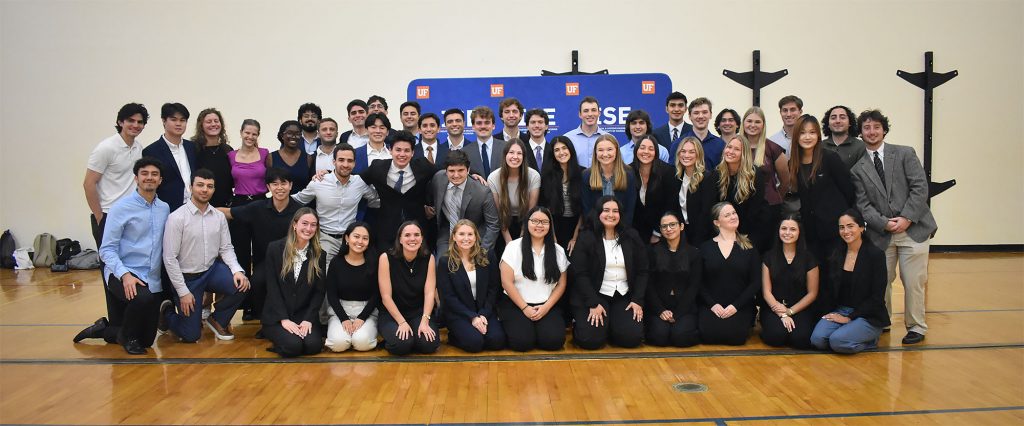
The buzz of innovation and real-world problem solving filled the Florida gym as Industrial and Systems Engineering undergrads presented their senior design and research posters at the annual symposium last week.
The University of Florida event brought together students and faculty to highlight months of collaboration, research and practical application of classroom learning. Instructional Associate Professor and Undergraduate Program Coordinator Katie Basinger-Ellis, Ph.D., said the symposium creates a space for students to share and discuss their scientific work.
The senior design projects spanned a variety of topics such as healthcare, manufacturing, supply-chain solutions and artificial intelligence. Poster topics represented a wide spectrum of interest and research, ranging from “Understanding AI Resume Scoring Behavior” to “Biomarkers: MTBI Symptom Prediction Based on MRI Imaging.”
The Best Senior Design Poster award for the poster “Improving Forecast Accuracy at Eaton Aerospace Through Predictive Modeling” went to the team of Tala Atway, Lorenzo Massobrio, Andrew McGrath, Nyla Pierre, Lily Sikorski and Victoria Zbierowski, who are advised by Rolande Willis Endowed Professor Yongpei Guan, Ph.D.
“The team effectively applied their industrial and systems engineering training to tackle a real forecasting challenge for Eaton Corp.,” Guan said. “Their teamwork, creativity and independence were truly impressive — an outstanding team in every respect.”
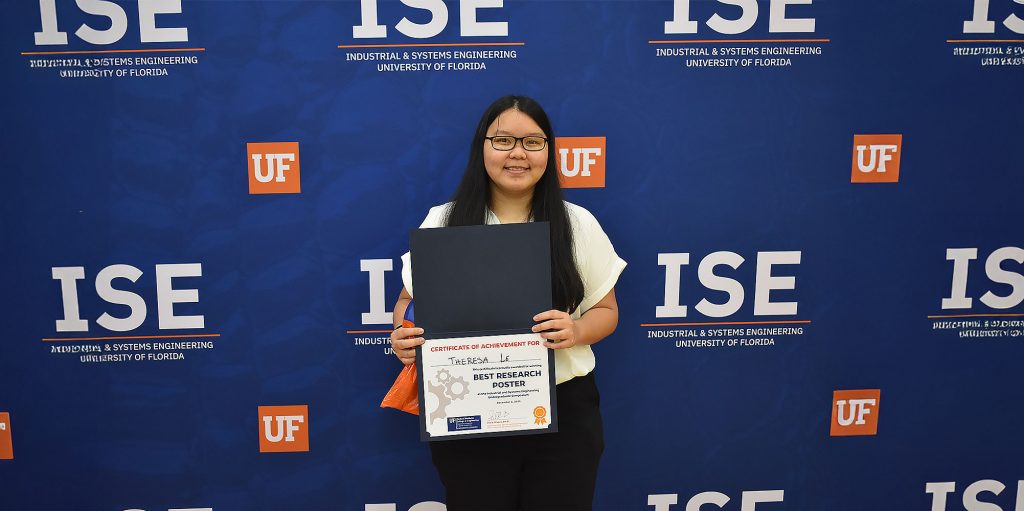
Senior Theresa Le earned the Best Research Poster award for her project “EEG and EMG Analysis of Brain and Muscle Activity During Functional Neck Movements.” Under the guidance of Associate Professor Suman K. Chowdhury, Ph.D., Le analyzed EEG and EMG data to compare brain and muscle activity in people with traumatic brain injuries to healthy participants to identify which areas of the brain are most active during specific tasks.
“I’ve learned there are a lot of steps in data analytics, from preprocessing and validating data to the actual analysis,” Le said. “The hands-on experience in the lab is the most rewarding part; we got to use EEG cables and EMG sensors on ourselves and others to learn the tools.”
Chowdhury praised Le’s initiative.
“Within a very short time, she learned and developed a robust EMG–EEG data processing pipeline, which is crucial to the success of our National Science Foundation project. Her work also laid the foundation for future researchers on my team to investigate concussion-associated neck motor impairment among various traumatic brain injury populations.”
Le also collaborated on another project, “Designing for Survival: Agent-Based Modeling of Active Shooter Responses in Retail Environments.”
Using Google Earth, her team reconstructed the layout of the El Paso Walmart, the site of a deadly mass shooting in 2019, to simulate how shoppers would respond to notification of a gunman. Their findings revealed that while early warnings increased the number of civilians able to escape, but it also resulted in higher casualties due to panic and logistical layout challenges, highlighting the complex dynamics of real-world emergencies.
Le said her path to ISE was not linear.
“I hopped around between different majors: civil engineering and computer engineering. I thought ISE was a good mix of applied skills,” she said. “A lot of classes are project-oriented, which really helped me stay engaged.”
The showcase demonstrated interdisciplinary research and the practical value of hands-on lab work, mentorship and peer collaboration to solve real-world engineering problems.